
If you searched for VPS Netherlands, Netherlands VPS, VPS hosting Netherlands, VPS in Netherlands, or cheap VPS Netherlands, this guide answers all of it in one place. We cover why the Netherlands is one of the best regions in Europe to host a server, what actually separates a good Dutch VPS from an oversold one, real 2026 pricing, and which plan fits which workload.
Quick answer: a good Netherlands VPS gives you KVM virtualization, NVMe storage, a clear bandwidth policy, DDoS protection included (not a paid extra), and low latency across Western Europe through Amsterdam's connectivity. Space-Node's VPS plans are hosted in the Netherlands, start at 5.50 EUR/month, and include KVM, NVMe, and DDoS protection on every tier. They are out of stock until about the end of October.
Why the Netherlands Is a Top Location for VPS Hosting
AMS-IX and Amsterdam's connectivity
Amsterdam hosts AMS-IX, one of the largest internet exchanges in the world. A large number of networks peer directly there, which means shorter, more direct routes for traffic moving across Europe and beyond. In practical terms, a well connected Netherlands VPS provider can offer sub-10ms latency to most EU countries, stronger peering with major networks, and fewer of the routing detours that add latency on less connected regions. For gaming, streaming, and anything else where every millisecond of ping counts, this matters more than raw CPU clock speed alone.
Dutch privacy law and GDPR
The Netherlands operates under GDPR alongside Dutch national data protection law, giving hosting customers clear rules about how data is processed and stored. That is useful whether you are running a business application that handles customer data or a personal project where you simply want a predictable legal environment.
Solid infrastructure as a default, not an upsell
Reliable power, redundant network paths, and modern cooling are table stakes for Dutch data centers rather than premium add-ons. Space-Node's Netherlands VPS infrastructure runs out of a Tier II data center with redundant power and cooling, and the Standard plans run on AMD Ryzen 9 3900X processors. The RAM in your plan is dedicated to your VPS; the vCores are shared with the other VPSes on the node.
What Actually Separates a Good Netherlands VPS From a Bad One
The headline price on a VPS listing tells you almost nothing on its own. These four things do.
Virtualization: KVM vs OpenVZ
| Technology | Isolation | What it means for you |
|---|---|---|
| KVM | Full virtual machine | Your own kernel choices, predictable performance, no noisy neighbor kernel sharing |
| OpenVZ / LXC | Shared kernel with host | Fine for a static site, a poor fit for game servers, Java, or anything that needs custom sysctl tuning |
If a listing just says "Linux VPS" without naming KVM, ask before you buy. Game servers and memory heavy Java processes are exactly where the difference between KVM and a container style VPS shows up first, usually as inconsistent tick rate or random stalls under load.
Storage: NVMe vs SSD vs HDD
| Storage Type | Typical Read Speed | Best For |
|---|---|---|
| NVMe | 3,500+ MB/s | Databases, game worlds, chunk loading, anything interactive |
| SSD | 500 to 550 MB/s | General purpose web hosting, light workloads |
| HDD | 100 to 150 MB/s | Cold backup storage only |
In 2026, NVMe is the baseline for any VPS you plan to interact with in real time. All Space-Node VPS plans use NVMe storage.
Bandwidth: what "unlimited" really means
Plenty of providers advertise unlimited bandwidth, then quietly throttle past an unpublished threshold. Before you commit, check whether the provider states a real fair use policy or hides behind the word "unlimited" with no detail at all. A busy Minecraft or FiveM server can move 500GB to several TB a month, so this line item is not academic.
DDoS protection: included, not an upsell
Netherlands servers, precisely because of how well connected the region is, are common attack targets. Protection should be always on rather than something that only kicks in reactively, and it should not be a paid add-on bolted onto an otherwise cheap plan. Every Space-Node VPS plan includes DDoS protection by default, scaling from enhanced mitigation on entry plans up to full DDoS protection on the higher tiers, and it is not billed separately.
Netherlands VPS Pricing in 2026 (Real Numbers)
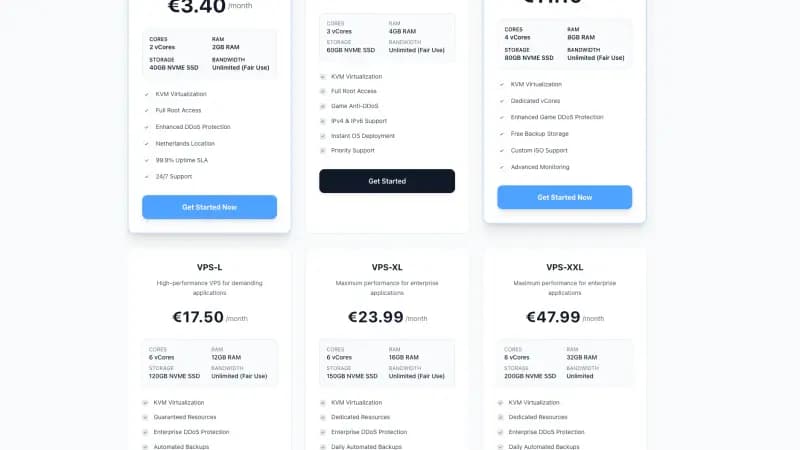
Rather than give you vague industry price bands, here is exactly what Space-Node's Netherlands VPS plans cost and include:
| Plan | Price | vCores | RAM | NVMe Storage | Bandwidth |
|---|---|---|---|---|---|
| VPS-S | €5.50/mo | 2 | 4GB | 40GB | 10 TB |
| VPS-M (most popular) | €11.10/mo | 3 | 8GB | 60GB | 30 TB |
| VPS-L | €17.50/mo | 4 | 12GB | 90GB | 30 TB |
| VPS-XL (most chosen) | €23.99/mo | 6 | 16GB | 120GB | 30 TB |
| VPS-XXL | €47.99/mo | 8 | 32GB | 200GB | 30 TB |
Every tier includes KVM virtualization, full root access, DDoS protection, and a 99.9% uptime SLA. If a plan outgrows you, extra vCores (€2.50/mo each), extra RAM (€1.50/mo per GB), extra NVMe storage (€2.00/mo per 20GB), backup storage (€3.00/mo per VPS), and extra IPv4 addresses (€2.00/mo, up to 4 per VPS) are all available add-ons rather than forcing a full plan upgrade.
Bandwidth is a monthly transfer allowance per plan on a 1 Gbps port, and DDoS protection is included on every plan rather than billed as an extra.
What to watch for on other "cheap VPS Netherlands" offers
A rock bottom price on a comparison site is rarely the full picture. Before you buy anywhere, check for:
- IPv4 surcharges stacked on top of a low base price
- Windows licensing fees added after the fact (Windows Server images typically cost extra wherever you host, plan for it up front)
- Paid control panels you may not actually need if you are comfortable with SSH
- Per-gigabyte snapshot and backup billing that adds up fast if you are not watching it
- CPU labeled as "vCPU" with no mention of contention. Ask how the vCores are shared and how much RAM is dedicated to you. On our plans the vCores are shared with the other VPSes on the node and the RAM is dedicated
- RAM shown as a burst ceiling rather than a guaranteed floor. Treat the guaranteed number as your real budget for a server that needs to stay online
Best Use Cases for a Netherlands VPS
Game servers. Minecraft, FiveM, Rust, ARK, and Valheim all benefit from the Netherlands' low EU latency, NVMe storage for fast world or resource loading, and included DDoS protection, which matters especially for FiveM servers that are common attack targets.
Web applications. E-commerce, SaaS, and API workloads targeting a European audience benefit from the same low latency that makes the region good for gaming.
24/7 streaming and media. Continuous YouTube or Twitch streams, media servers like Plex or Jellyfin, and transcoding workloads all lean on the stable, well peered network a Netherlands datacenter provides.
VPN and privacy tooling. WireGuard or OpenVPN endpoints are a common use case for a Netherlands VPS, combining GDPR-governed hosting with strong EU connectivity.
Development, staging, and CI. Mirroring production closer to EU users, running CI runners, or hosting internal dashboards and preview environments.
Windows or Linux, and How You Pay
Two questions come up constantly enough in this space that they deserve their own dedicated answers rather than a paragraph buried here:
- If your workload specifically needs Windows (RDP access, Windows-only software, legacy tooling), read our dedicated Cheap Windows VPS Netherlands guide for RAM overhead, licensing, and RDP security specifics before you order.
- If you want to pay with Bitcoin or another cryptocurrency, our Netherlands VPS with crypto payment guide covers what crypto payment actually does and does not do for privacy, and what to check before you send funds.
For most workloads, Linux (Ubuntu 22.04/24.04 LTS or Debian 12) is the more cost effective and better performing default, so start there unless you have a specific reason not to.
A Simple Decision Framework
Before you buy any Netherlands VPS, answer three questions:
- Who uses the service? A personal lab, paying customers, or a public game community changes how much risk you can tolerate on cheap, oversold infrastructure.
- What breaks if the VPS is slow for an hour? If the answer is "my players or users notice," prioritize stable CPU and disk performance over the absolute lowest monthly price.
- How will you restore data if something goes wrong? If you cannot answer that in one sentence, sort out backups before you optimize price.
Initial Setup Once You Have a Netherlands VPS
# Update the system
apt update && apt upgrade -y

# Create a non-root user
adduser yourusername
usermod -aG sudo yourusername

# Set up SSH key authentication, then disable password login
mkdir -p ~/.ssh
# add your public key to ~/.ssh/authorized_keys
nano /etc/ssh/sshd_config
# set: PasswordAuthentication no
systemctl restart sshd

# Enable a basic firewall
ufw allow ssh
ufw allow http
ufw allow https
ufw enable
From there, install whatever your workload needs: Nginx or Caddy for web apps, Docker for containerized services, or your game server's specific software.
Frequently Asked Questions
Is a Netherlands VPS good for Minecraft or other game servers?
Yes. The Netherlands offers strong latency to all of Western and much of Eastern Europe, and NVMe storage keeps chunk loading and world saves fast. Combined with DDoS protection included by default, it is one of the strongest regions in Europe for hosting an EU-facing game community.
What is the cheapest Netherlands VPS that is still actually usable in 2026?
Space-Node's smallest plan, VPS-S, costs €5.50/month for 2 vCores, 4GB RAM and 40GB NVMe storage, with KVM virtualization and DDoS protection included rather than billed separately. Extra storage can be added to any plan at a higher price per GB. Update 27 September 2026: our VPS plans are temporarily out of stock and expected back around the end of October; ask us in live chat or on Discord if you need something before then.
Why is the Netherlands so popular for VPS hosting specifically?
Amsterdam hosts AMS-IX, one of the world's largest internet exchanges, which gives Netherlands-based servers excellent routes across Europe and reasonable paths to North America and Asia. Combine that with GDPR-governed privacy rules and reliable infrastructure, and it is a strong default region for gaming, business, and privacy-focused workloads alike.
Can I run a VPN on a Netherlands VPS?
Yes. WireGuard and OpenVPN are common workloads on a Netherlands VPS, and the region's privacy laws and connectivity make it a popular choice for this use case specifically.
Do I need KVM, or is a cheaper container-based VPS fine?
For anything that needs to run reliably 24/7, especially a game server or a Java process, KVM is worth insisting on. Container platforms like OpenVZ share a kernel with the host and other tenants, which can cause inconsistent performance under load in a way a real KVM instance will not.
What's the difference between a Netherlands VPS and shared hosting?
A VPS gives you your own RAM and storage with full root access to install anything you want. On our plans the RAM is dedicated to your VPS and the vCores are shared with the other VPSes on the node. Shared hosting places your site on the same machine as hundreds of others with limited control. For game servers, bots, or applications, a VPS is close to essential. For a simple blog, shared hosting can still be enough.
Related Guides
- Minecraft Server Hosting Netherlands: Complete Guide
- Cheap Windows VPS Netherlands 2026
- Netherlands VPS With Crypto Payment 2026
- Amsterdam VPS Hosting vs Netherlands VPS
- How to Set Up WireGuard VPN on a VPS
- VPS Streaming Setup for 24/7 Broadcasts
See current Space-Node VPS plans and pricing →
Related: Planning VPS scalability without over provisioning, Ollama and Self-Hosted LLMs on a VPS