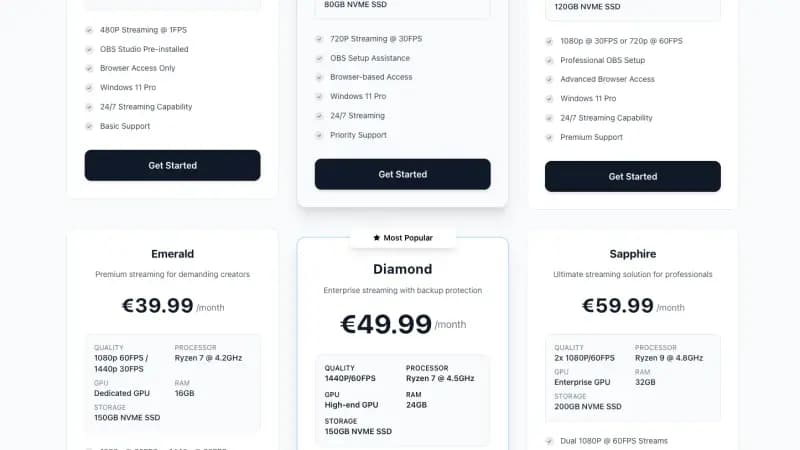
Quick answer: Streaming RDP is often just a shared Windows desktop. A streaming VPS gives you clearer resources, plan ownership, and a setup designed for OBS or live video.
Who this guide is for
Use this if you found cheap RDP offers and wonder whether they can run OBS for YouTube, Twitch, Kick, radio visuals, or 24/7 loops.
Recommended baseline
| Scenario | Baseline | Notes |
|---|---|---|
| Cheap shared RDP | Testing only | Neighbors can affect performance |
| Windows VPS | Light OBS or admin work | Better isolation |
| Streaming VPS | 24/7 OBS and live video | Built for continuous broadcast |
| Dedicated streaming server | Agency or multi-channel work | Best isolation |
Setup checklist
- Ask whether CPU is shared or dedicated.
- Check if OBS is allowed by the provider.
- Avoid unknown RDP sellers for monetized channels.
- Make sure you can restart and recover the machine.
- Prefer a provider that understands streaming support.
Common mistakes
- Buying a random RDP account for a serious channel.
- Ignoring terms of service for continuous encoding.
- Assuming RDP means GPU support.
- Saving a few euros and losing uptime.
Space-Node recommendation
Use Space-Node Streaming VPS when the goal is OBS uptime. Use VPS hosting if you only need a normal Windows or Linux server.
FAQ
Can I start smaller and upgrade later?
Yes. Start with the smallest plan that fits the baseline, monitor CPU, RAM, disk, and network for a few real sessions, then upgrade when the graphs show a bottleneck. Guessing too high wastes money. Guessing too low creates downtime.
Is bandwidth or CPU more important?
It depends on the workload. Video streaming cares about stable outbound bandwidth and encoding headroom. Minecraft, FiveM, Discord bots, and n8n usually hit CPU, RAM, database, or bad configuration first.
Should I use a VPS or a managed product?
Use a managed product when you want speed and support. Use a VPS when you need root access, custom software, Docker, or unusual workflows. If the workload is public or revenue critical, avoid anonymous ultra-cheap hosts with unclear limits.