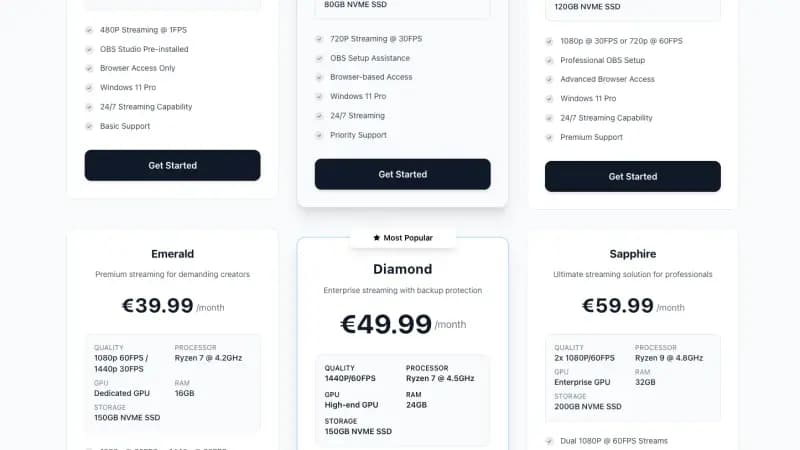
Quick answer: For a 24/7 OBS VPS, start with 720p30 or 1080p30, CBR bitrate, simple scenes, auto reconnect, and hardware or dedicated encoding only when the plan supports it.
Who this guide is for
This guide is for creators who want OBS running in the cloud for lofi channels, radio visuals, sports scoreboards, church streams, replay loops, or multistream setups.
Recommended baseline
| Scenario | Baseline | Notes |
|---|---|---|
| 720p30 | 2500 to 4000 Kbps | Low risk starter setting |
| 1080p30 | 4500 to 6000 Kbps | Best balance for most 24/7 channels |
| 1080p60 | 6000 to 9000 Kbps | Needs stronger CPU or GPU encoding |
| 1440p60 | 9000 to 18000 Kbps | Use only with strong plan and platform support |
Setup checklist
- Set rate control to CBR for platform stability.
- Use a keyframe interval of 2 seconds.
- Limit browser sources and animated overlays.
- Turn on OBS reconnect with a sensible retry delay.
- Keep one fallback scene with a static image and audio loop.
Common mistakes
- Chasing 1080p60 before testing 1080p30 for 24 hours.
- Using dozens of browser widgets on a small VPS.
- Leaving Windows updates to reboot the stream during peak hours.
- Uploading huge local media files without checking disk space.
Space-Node recommendation
If you want OBS preinstalled and browser access, use Streaming VPS plans. If you prefer a script-first FFmpeg stack, use VPS hosting.
FAQ
Can I start smaller and upgrade later?
Yes. Start with the smallest plan that fits the baseline, monitor CPU, RAM, disk, and network for a few real sessions, then upgrade when the graphs show a bottleneck. Guessing too high wastes money. Guessing too low creates downtime.
Is bandwidth or CPU more important?
It depends on the workload. Video streaming cares about stable outbound bandwidth and encoding headroom. Minecraft, FiveM, Discord bots, and n8n usually hit CPU, RAM, database, or bad configuration first.
Should I use a VPS or a managed product?
Use a managed product when you want speed and support. Use a VPS when you need root access, custom software, Docker, or unusual workflows. If the workload is public or revenue critical, avoid anonymous ultra-cheap hosts with unclear limits.