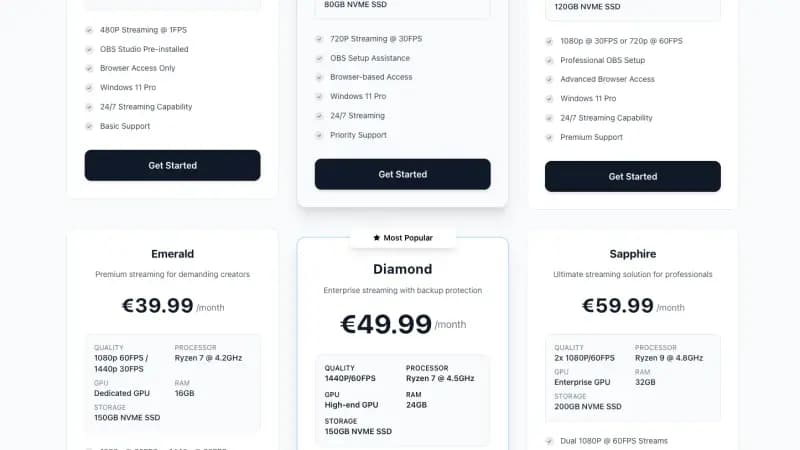
Quick answer: OBS cloud means running OBS on a remote server. It is best when you need stable 24/7 uptime, remote management, or stronger upload than your home connection.
Who this guide is for
This guide is for creators searching for a cloud OBS setup for YouTube, Twitch, Kick, lofi channels, live counters, radio visuals, or automated broadcasts.
Recommended baseline
| Scenario | Baseline | Notes |
|---|---|---|
| Simple OBS scene | 4 vCPU, 8 GB RAM | Start here for 720p/1080p30 |
| Browser overlays | 6 vCPU, 12 GB RAM | More headroom |
| 1080p60 | Dedicated streaming plan | Encoding load is higher |
| Multistream | Higher plan or relay setup | Output bandwidth matters |
Setup checklist
- Keep scenes simple for long uptime.
- Use persistent media paths.
- Turn on reconnects.
- Secure remote access.
- Test the stream before promoting it.
Common mistakes
- Treating OBS cloud like free SaaS.
- Using unsupported GPU claims from unknown providers.
- Leaving stream keys visible in browser sources.
- Forgetting Windows reboot settings.
Space-Node recommendation
Use Space-Node Streaming VPS for OBS cloud workflows with browser access and support.
FAQ
Can I start smaller and upgrade later?
Yes. Start with the smallest plan that fits the baseline, monitor CPU, RAM, disk, and network for a few real sessions, then upgrade when the graphs show a bottleneck. Guessing too high wastes money. Guessing too low creates downtime.
Is bandwidth or CPU more important?
It depends on the workload. Video streaming cares about stable outbound bandwidth and encoding headroom. Minecraft, FiveM, Discord bots, and n8n usually hit CPU, RAM, database, or bad configuration first.
Should I use a VPS or a managed product?
Use a managed product when you want speed and support. Use a VPS when you need root access, custom software, Docker, or unusual workflows. If the workload is public or revenue critical, avoid anonymous ultra-cheap hosts with unclear limits.