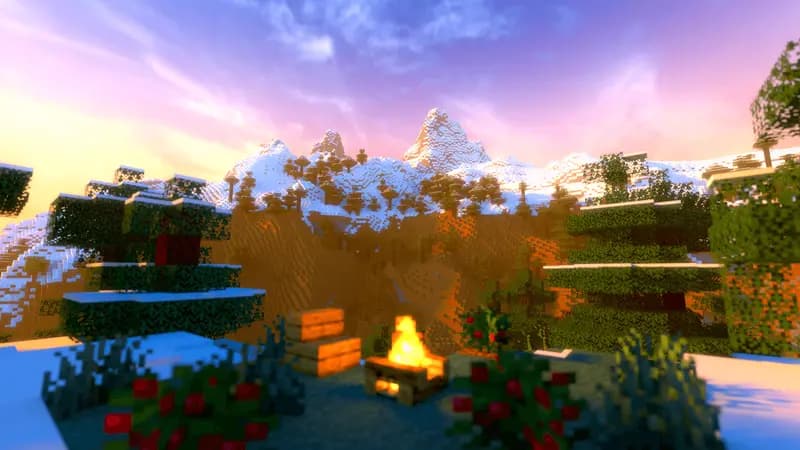
If you have ever hosted a modded Minecraft server-especially massive payloads like All The Mods 10 (ATM10)-you are intimately familiar with the exploration lag spike. Your server is running at a perfect 20.0 TPS (Ticks Per Second) while everyone is building at spawn. Then, a single player equips an Elytra and starts flying in a straight line into unexplored territory.
Instantly, the TPS plummets to 3.0. Block breaking is delayed by ten seconds. Mobs freeze in place. The console is spammed with "Can't keep up! Is the server overloaded?" warnings.
This isn't necessarily a failure of your hardware; it's a failure of physics. This guide explains exactly why exploring unexplored terrain is the most resource-intensive action in Minecraft, and how you can permanently solve this issue using a world pre-generation tool like Chunky.
The Anatomy of a Lag Spike
To understand the solution, you must understand the problem. When a player enters an unexplored area, the server cannot simply load the terrain from the hard drive-because the terrain does not exist yet. It must be created from scratch.
This process forces the server's CPU to execute complex mathematical algorithms to determine the biome, generate the heightmap, calculate cave systems, place ores, and spawn structures like villages or modded dungeons. In a heavy modpack with hundreds of custom biomes and structures, this calculation is much more difficult than in vanilla Minecraft.
If a player is flying quickly, they are forcing the server to perform these massive calculations dozens of times every second. This instantly drives CPU use to 100%, starving the rest of the game of processing power and causing the server to lag catastrophically.
The Solution: World Pre-Generation
The only way to completely eliminate exploration lag is to ensure the server never has to calculate new terrain while players are online. You achieve this through world pre-generation.
Pre-generation involves artificially forcing the server to calculate and save a massive section of the map while no players are online. Once the terrain is generated and saved to the storage drive, the server only has to load the data when a player enters the area, rather than calculating it. Loading data from a fast NVMe drive requires almost zero CPU effort.
How to Pre-Generate Your World Using Chunky
The undisputed standard for world pre-generation in 2026 is a server-side mod (and plugin) called Chunky.
Here is the step-by-step process for using Chunky effectively:
1. Installation
Ensure Chunky is installed in your mods/ or plugins/ directory. It is a server-side utility, meaning your players do not need it installed on their local clients.
2. Setting the Boundaries
Before generating, you must define the area. Open your server console (or type in-game if you have OP permissions) and set a world border to prevent players from wandering outside the pre-generated area:
/worldborder center 0 0
/worldborder set 10000
(This creates a border 5,000 blocks in every direction from the center point, creating a 10,000x10,000 block arena.)
3. Configuring Chunky
Now, tell Chunky to target that same area:
/chunky radius 5000
4. Starting the Generation
Finally, begin the process:
/chunky start
Setting Realistic Expectations
Pre-generation is a marathon, not a sprint.
If you are running an advanced AMD Ryzen 9 processor, generating a 5,000-block radius might take anywhere from 12 to 24 hours of continuous calculation. Do not attempt this while players are online; the server will be completely unplayable.
Also, generated terrain requires physical storage space. A 5,000-block radius map in a heavy modpack can easily consume 10GB to 15GB of disk space. This is a critical factor when choosing a hosting provider.
Why Hardware Still Matters
Pre-generation solves the CPU bottleneck of exploration, but it introduces a new requirement: fast storage.
When players fly through your pre-generated world, the server must read massive amounts of chunk data from the disk and send it to the players. If you are using a host with traditional Hard Disk Drives (HDDs) or cheap SATA SSDs, the drive will fail to read the data fast enough, resulting in "chunk-loading stutter."
This is why serious communities require dedicated infrastructure. Space-Node's premium plans are built using dedicated NVMe Solid State Drives. NVMe drives communicate directly with the motherboard, ensuring that even if five players are flying in different directions simultaneously, the terrain loads instantly. Also, our plans offer ample storage capacities, ensuring you have the room to pre-generate massive worlds without hitting artificial limits.
Pre-generate your world, use NVMe storage, and watch exploration lag disappear permanently.