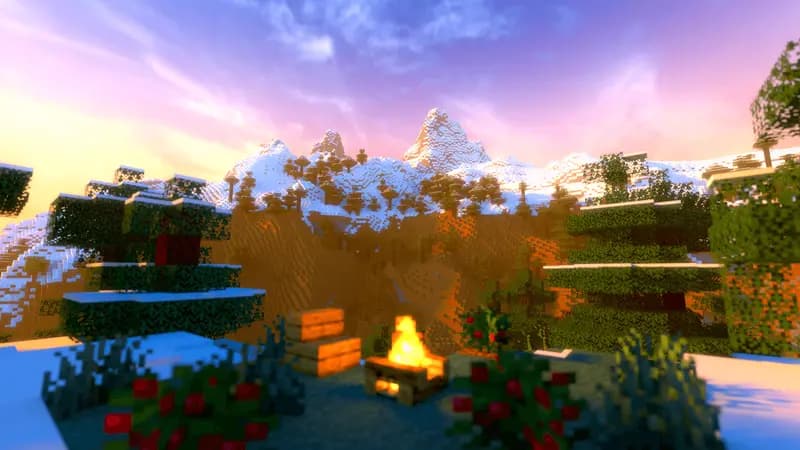
Sodium and Iris are the modern Fabric rendering stack: Sodium rewrites Minecraft's renderer for huge FPS gains, and Iris adds shader support on top while keeping that performance. The combination lets you run good-looking shaders at frame rates OptiFine could never reach. Here are the shader packs worth running in 2026, ranked by what you actually get for the FPS cost.
Quick setup: Sodium + Iris
Iris bundles Sodium, so you only install one mod:
- Install Fabric Loader for your Minecraft version.
- Download Iris (it includes a compatible Sodium build) and drop it in your
modsfolder. - Launch the game, open Options → Video Settings → Shader Packs, and add your
.zipshader to the folder it opens.
That is it. No OptiFine, no manual Sodium download.
The best shader packs
1. Complementary Reimagined / Unbound
The default recommendation for most players. Complementary is bright, sharp, and incredibly configurable, with two flavours: Reimagined (stylised, vibrant) and Unbound (more realistic). It runs well on mid-range GPUs and exposes hundreds of toggles, so you can dial quality up or down to hit your target FPS.
- Best for: all-rounder, survival, building
- Performance: excellent for what it looks like
2. Bliss
A fork lineage known for gorgeous lighting and clouds with a clean, slightly dreamy look. Bliss is a bit heavier than Complementary but rewards you with some of the best skies in any pack.
- Best for: screenshots, cinematic builds
- Performance: medium
3. Photon
A newer pack focused on realistic atmospherics: volumetric fog, strong sky modelling, and natural colour. Photon looks fantastic and is reasonably efficient for a "realistic" pack.
- Best for: realism without the heaviest cost
- Performance: medium
4. Rethinking Voxels
Built on Complementary but adds coloured voxel lighting so torches, lava, and glowing blocks cast accurate coloured light. It is genuinely beautiful and the most GPU-hungry pick here. Save it for a strong GPU.
- Best for: the prettiest lighting, high-end GPUs
- Performance: heavy
5. Make Up - Ultra Fast
When you want shaders but refuse to lose frames, Make Up's Ultra Fast profile gives you soft shadows and nicer water at a fraction of the cost of the realistic packs.
- Best for: lower-end GPUs, high-refresh play
- Performance: light
Performance settings that matter
Even the lightest shader is GPU-bound. To keep FPS high:
- Shadow resolution / distance is the single biggest cost. Drop shadow distance first.
- Render distance multiplies shader cost. 12-16 chunks is a sweet spot with shaders.
- Disable volumetric/cloud fog and screen-space reflections if you need frames back.
- Keep Sodium's own settings tuned: enable fast mipmaps and leave entity culling on.
Shaders and your server
Shaders are entirely client-side: they change how your PC draws the world and have zero effect on the server. A well-run server still matters for shaders, though, because a stable tick rate keeps entities and chunks loading smoothly so your shaders are not rendering a stuttering world. If you run a modded or high-render-distance world, host it somewhere with fast cores and NVMe storage so the server keeps up with what your GPU is drawing.
Our Minecraft hosting runs every server on Ryzen 9 hardware with NVMe SSD, so Fabric worlds with Sodium clients on the other end stay smooth.
Bottom line
Start with Complementary Unbound for the best balance of looks and FPS, step up to Bliss or Photon for screenshots, reach for Rethinking Voxels if your GPU can take it, and fall back to Make Up Ultra Fast when frames matter most. All of them run great on the Sodium + Iris stack.
Running a Fabric world? → View Space-Node Minecraft hosting - Ryzen 9 hardware, NVMe SSD, and one-click Fabric setup.