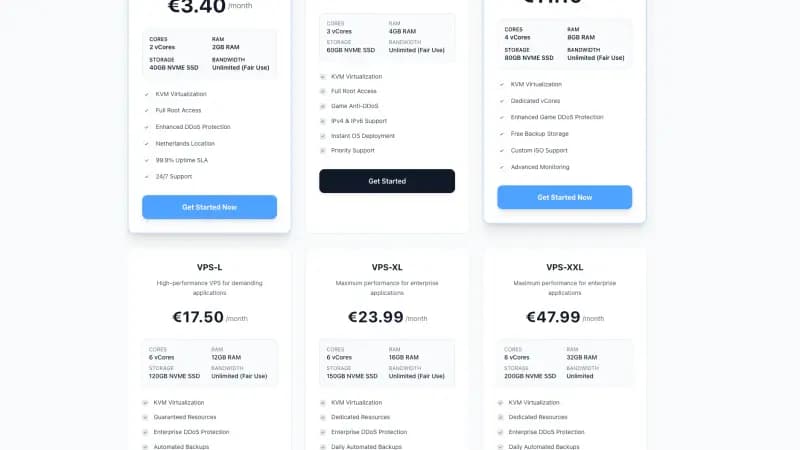
You see a hosting plan for €1.00 per month. You think: this is a deal. Then your server lags with 5 players online, chunks refuse to load, and the support ticket goes unanswered for three days.
This is not bad luck. It is a predictable outcome of how budget hosting actually works.
The Overselling Problem
Budget hosting providers sell the same physical CPU to hundreds of customers simultaneously. A single physical server with 16 cores gets divided into 200+ "shared" slots. Everyone gets a fraction of a fraction of real processing power.
Minecraft's main game loop runs almost entirely on one thread. That thread needs fast, uninterrupted clock cycles to process player movement, block updates, entity AI, and chunk generation on every tick. When you share that CPU time with 199 other servers, your tick rate drops. Your server lags at 12 TPS instead of 20. It feels broken.
The fix is not buying more RAM. The fix is a faster CPU.
Why Clock Speed Beats Core Count for Minecraft
Modern high-core CPUs like the AMD Ryzen 9 9950X have both. But when you are evaluating a host, ask specifically about the CPU model and its base and boost clock speeds.
Here is why it matters:
- Minecraft's main tick loop runs single-threaded
- A 4.5 GHz core finishes one tick in milliseconds; a 2.4 GHz shared core does not
- Modpacks with 300+ mods generate deep dependency chains that compound this problem
A server running on a Ryzen 9 7950X (up to 5.7 GHz boost) processes the same workload much faster than a generic €1/month host running a throttled Xeon from 2019.
Storage Is the Other Hidden Bottleneck
Every time a player enters a new area, the server reads chunk data from disk. On a standard SATA SSD, this takes 3 to 5 milliseconds per chunk cluster. On NVMe, it drops below 0.5 milliseconds.
That difference is invisible to a player on a nearly empty server. Put 20 players on a vanilla world and all spread out in different directions at the same time. On SATA, the server stalls. On NVMe, chunks load before the client notices.
Budget hosts use mechanical hard drives or old SATA SSDs pooled across hundreds of customers. Your disk reads compete with everyone else's.
What "Resource Allocation" Actually Means
When a host advertises "4 GB RAM for €1.99/month," ask what sits underneath that allocation. There are two fundamentally different architectures:
Shared oversold hosting: Your 4 GB of RAM is one of 300 slices on a machine with 128 GB. During peak hours, the host's hypervisor spends significant time swapping and deprioritizing. Your server gets 4 GB in theory. In practice, it gets what is left over.
Reserved allocation: Your GB of RAM is reserved and no other tenant touches it. The CPU is shared with the other servers on the node, within the limit your plan sets, so the CPU model and how full the node is decide how your server behaves under load.
The difference shows up immediately when multiple players join at the same time, when a modpack initializes on startup, or when a large explosion triggers hundreds of block updates simultaneously.
Pricing Tiers and What You Should Expect
This is a rough guide based on real hardware costs in 2026:
| Monthly Price | What You Normally Get | Typical Problems |
|---|---|---|
| €1.00 to €2.50 | Heavily oversold shared hosting | Constant lag, slow chunk loading, poor support |
| €3.00 to €6.00 | Better allocation, often still shared CPU | Acceptable for vanilla, struggles with mods |
| €7.00 to €15.00 | Reserved RAM, NVMe, modern Ryzen | Reliable for modpacks up to ~300 mods |
| €15.00+ | High-frequency Ryzen, full isolation | ATM10, 50+ players, heavy plugin stacks |
Paying €1.99/month for a Minecraft server that lags constantly, then paying again for an upgrade you need anyway, costs more than buying the right plan the first time.
The Vertical Scaling Advantage
When your server grows, you need to scale up quickly. With shared hosting, this means migrating to an entirely new provider, reconfiguring everything, and hoping your data transfers correctly.
With a properly structured hosting setup using a panel like Pterodactyl, upgrading is a slider change. Your RAM increases. Your CPU allocation increases. Your server does not go offline for hours while files copy across servers.
This is not a marketing promise. It is a function of containerized architecture where resources are pre-defined per instance and adjustable without physical migration.
Questions to Ask Before You Buy
Before committing to any hosting plan, ask the provider these things:
- What is the exact CPU model on this node?
- Are CPU threads dedicated or shared?
- Is storage NVMe or SATA?
- How many servers share the same physical host?
- What DDoS mitigation is included, and at what bandwidth cap?
If they refuse to answer or give vague responses, that tells you everything about what you are buying.
The Bottom Line
Cheap hosting is cheap because the provider sells the same hardware to far more customers than it was designed to support. For a private server with a few friends on vanilla Minecraft, that trade-off might be acceptable. For anything involving mods, plugins, or more than 10 players, you will feel the difference every time you log in.
The economics are simple. Fast hardware costs money. When a plan costs less than a cup of coffee per month, that hardware is not what you are getting.
At Space-Node, every game server plan runs on AMD Ryzen 9 processors with NVMe storage, and the CPU model is listed for every region. The RAM in your plan is reserved for your server; the CPU is shared with other servers on the node, and Minecraft Premium plans in the Netherlands, Germany, Poland and Canada get 600 to 800% CPU (6 to 8 vCores) under fair use. You pay for what you use. You get what you pay for.