If your YouTube Live stream looks blurry, buffers, or randomly drops quality, the problem is usually not YouTube. It is your encoder settings, your bitrate stability, or your server connection.
This guide gives you a clean baseline for 1080p60 and explains what to change depending on whether you use CPU encoding or a GPU encoder.
Table of Contents
- The goal for 1080p60 on YouTube
- A safe baseline OBS profile
- Why you get dropped frames
- How to set bitrate for a 24/7 stream
- When a VPS or streaming server makes sense
1. The goal for 1080p60 on YouTube
For YouTube Live, consistency matters more than perfect quality. A stable 8,000 kbps stream that never drops is better than a 15,000 kbps stream that stalls every hour.
You want your encoder to run cool, your upload to be stable, and your stream to survive restarts.
2. A safe baseline OBS profile
Start with a baseline and then adjust.
Set your base canvas to 1920x1080 and output resolution to 1920x1080.
Set FPS to 60.
Use CBR for rate control.
Choose a bitrate that your connection can hold all day, not just during a speed test. Many people pick a bitrate that works at night and fails during peak hours.
If you use a GPU encoder, use NVENC if you have NVIDIA. If you do not, use your platform's hardware encoder.
If you use CPU encoding, use x264 with a preset that does not overload your CPU.
3. Why you get dropped frames
Dropped frames in OBS are usually network dropped frames, not rendering issues.
That means your upload is not stable, your route to YouTube is inconsistent, or your server is being throttled.
If you stream from home, even a fast connection can have micro drops. Those micro drops are enough to make your stream buffer.
If you stream from a server, you reduce home network problems, but you still need a reliable host and a good route.
4. How to set bitrate for a 24/7 stream
For a 24/7 stream, the best approach is to choose a bitrate that is boring. It should run forever.
A lot of 24/7 channels fail because they push bitrate too high. They want maximum quality, then the stream dies during peak hours.
If your content is mostly static, like a loop, a music stream, or a camera feed, you can use a lower bitrate and still look good.
If your content is high motion, like gameplay, you need more bitrate. But you still want stability.
5. When a VPS or streaming server makes sense
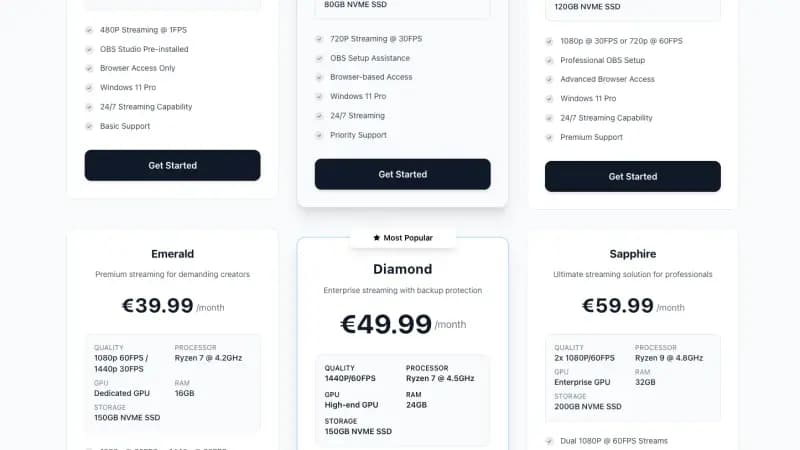
If your goal is a 24/7 YouTube stream, a dedicated streaming server can be easier than running OBS on your main PC forever.
A streaming server can run all day, avoid home network interruptions, and keep the stream stable while you sleep.
If you want to see what that looks like, Space-Node has streaming servers at /streaming and VPS options at /vps-hosting.
If you are setting up a full 24/7 workflow, this guide also pairs well with /blog/how-to-run-247-youtube-stream-2026.