Reselling hosting is one of the lowest-barrier entries into the tech business world. You don't need to own servers or manage infrastructure - you need business sense and customer focus.
What Reseller Hosting Is
You buy hosting resources wholesale from an infrastructure provider. You sell them retail under your own brand. The provider manages hardware, network, and uptime. You manage customers, support, and billing.
It's the same model as every retail business: buy low, add value, sell higher.
Why It Works
- Low startup costs: No server purchases, no datacenter contracts
- Recurring revenue: Monthly subscriptions create predictable income
- Scalable: Add customers without proportional cost increases
- Location independent: Manage from anywhere
- Technical barrier is manageable: You need hosting knowledge, not engineering expertise
Business Planning
Choose Your Niche
Don't sell "general hosting." Specialize:
- Game server hosting (Minecraft, FiveM, Rust)
- WordPress hosting for small businesses
- Discord bot hosting for communities
- VPS for developers
- Streaming infrastructure for content creators
Specialization means less competition and deeper expertise.
Revenue Projections
Example with game server reselling:
- Wholesale cost: €30/month for a dedicated server
- Split into 5 game server plans at €10-20/month each
- Revenue: €50-100/month per server
- Margin: 40-70%
At 10 servers with 50 customers: €500-1000 monthly revenue.
Legal Basics
- Register a business entity (LLC, sole proprietorship, etc.)
- Create Terms of Service (use templates, have a lawyer review)
- Privacy Policy (required by GDPR in Europe)
- Payment processing (Stripe, PayPal Business)
- Invoicing system
Infrastructure
Choosing a Provider
Look for:
- Reliable hardware (modern CPUs, NVMe SSD)
- Good network (DDoS protection, low latency)
- White-label support (no provider branding visible to your customers)
- API access (for automation)
- Fair pricing with volume discounts
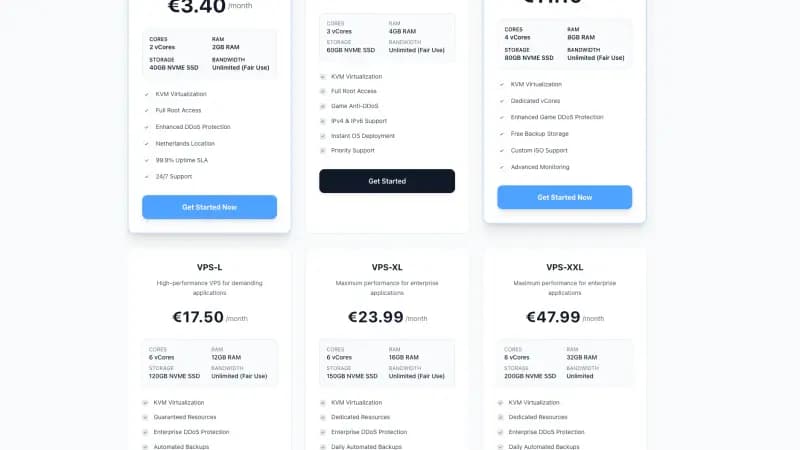
Space-Node provides the infrastructure backbone: Ryzen 9 9950X, DDR5, NVMe, Netherlands location, and DDoS protection, all without visible Space-Node branding to your end customers.
Panel Setup
- WHMCS or Blesta: Billing and client management
- Pterodactyl: Game server control panel
- cPanel/Plesk: Web hosting control panel
- Custom panel: If you have development resources
Branding
What You Need
- Business name and domain
- Logo (Fiverr or 99designs for budget)
- Website (landing page with plans and features)
- Support system (ticket system, Discord, or email)
- Brand colors and visual identity
Your Website
Your website is your storefront. It needs:
- Clear plan pricing
- Feature comparisons
- Trust signals (uptime guarantee, DDoS protection, support hours)
- Easy signup flow
- Knowledge base for common questions
First Customers
Where to Find Them
- Gaming communities (Discord servers, forums)
- Social media (Reddit r/admincraft, Twitter, YouTube)
- Content marketing (blog articles about the games you host)
- Word of mouth (happy customers tell friends)
- Partnerships with content creators
Pricing Strategy
Start competitive but not cheapest. Racing to the bottom attracts price-sensitive customers who leave for any cheaper option. Compete on quality, support, and specialization.
Growth Path
- Month 1-3: 5-10 customers, learning operations
- Month 3-6: 20-50 customers, refining support processes
- Month 6-12: 50-100 customers, considering automation
- Year 2+: 100+ customers, potentially hiring support staff
Common Mistakes
- Starting too broad (sell everything to everyone)
- Underpricing (can't sustain support quality)
- Over-promising (guarantees you can't keep)
- Ignoring support (customers leave for better support, not better hardware)
- Not automating (manual provisioning doesn't scale)
What hosting reselling actually is
Hosting reselling is buying capacity in bulk from a provider and selling it under your own brand. Three flavors exist, and they are very different businesses:
| Model | Margin | Effort | Risk |
|---|---|---|---|
| Pure reseller (panel only) | 10-20 % | low (no infra) | provider fails = your customers go down |
| White-label dedicated nodes | 30-50 % | medium (panel + ops) | you handle Pterodactyl, billing, panel updates |
| Owning hardware in colo | 50-70 % | high (DC trips, hardware) | you replace failed disks |
Most "How to start a hosting business" guides skip this distinction and assume model 1.
What you actually need to launch
- A wholesale provider that allows reselling under your brand. Hetzner, OVH bare metal, and several smaller EU providers do.
- A panel: Pterodactyl (free) or AMP (paid). Self-hosted on a small VPS.
- Billing: WHMCS (paid, integrates with Pterodactyl), WemX (newer, Pterodactyl-native), or Blesta.
- Payment processor: Stripe is the cleanest; PayPal as a backup. Crypto only if you understand the chargebacks risk.
- Domain + SSL: ~€20/year combined.
- Brand and copy that doesn't sound like five other hosts: this is the hardest part.
The numbers that decide if it works
Average modded Minecraft customer pays €8/month for 4 GB. Wholesale cost on a Ryzen node at decent density: €1.50-2.50 per customer. Fixed costs (panel VPS, billing software, domain): ~€20/month.
Break-even on a single 64 GB wholesale node: 8-12 paying customers. Realistic time to reach this: 3-6 months for a brand without an existing community, 1-2 months if you already have a Discord with a few hundred active users.
Why most resellers quit in year one
- Underestimating support time: a 24/7 promise means someone answers tickets at 3 AM.
- DDoS attacks at scale: at 50+ customers, you'll see attacks weekly.
- Refund chargebacks: 1-2 % of payment volume eats margin.
- Provider cost increases: wholesale prices rose 8-15 % between 2023 and 2026.
- Pricing race-to-bottom: some competitors lose money to grow; matching them kills margin.
The brands that grow have at least two upstream providers, transparent status pages, real human responses within an hour during peak hours, and a niche (RP servers, modded specifically, EU-only) instead of "we host everything for everyone".
Legal/compliance basics (EU 2026)
- VAT registration once you cross your country's threshold (varies, typically €10k-€85k/year).
- GDPR-compliant privacy policy. Generic templates are fine for hosting.
- Terms of Service that match your provider's AUP. If your upstream forbids cryptomining, your TOS must too.
When NOT to start a reseller business
- You can't commit 1+ hour/day to support for the first six months.
- You don't have a community or audience to bootstrap from.
- Your only differentiator is "cheaper than X". Pricing wars are won by who can lose money longest.
When the math works, reselling is a real business. When it doesn't, you're underwriting your competitors' growth.